Kuvaus
Having great skills is not the reason you are not getting opportunities in Finland.
Because if skills alone were enough, you would already have them.
The real problem is this:
👉 your skills are not being understood as something a company can buy
And in Finland, that matters more than you think.
Finnish companies do not hire the loudest expert. They do not hire the one with the longest CV. And they very rarely take risks on someone they do not fully understand.
They hire the person who feels like a safe, logical decision in their situation.
Someone who clearly solves a problem they already have.
Someone who does not create more uncertainty.
At the same time, most real opportunities never even reach job boards.
They exist in conversations, networks, internal discussions, and situations where a company knows it needs help but has not yet defined what that help looks like.
This is where people get stuck.
They keep applying.
They keep improving their CV.
They keep waiting for the ”right” opportunity to appear.
While someone else gets the role simply because they positioned their skills in a way that made sense to the company.
This course is built to change that.
You will not learn how to send more applications.
You will learn how to make your expertise understandable, relevant, and easy to say yes to.
You will learn how Finnish companies actually make decisions.
You will learn how to reduce the perceived risk of hiring you.
And you will learn how to position yourself so that opportunities start coming to you, not the other way around.
What makes this different
Most courses focus on one path.
This one shows you five.
Because your skills are not limited to one way of working, even if you have been taught to think that way.
In this course, you will learn how to sell your expertise through five different working models:
Traditional employment
When a company needs stability, continuity, and someone who can take ownership long-term.
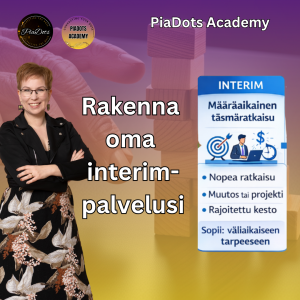
Interim roles
When a company needs someone to step in full-time for a limited period and lead through a specific situation.
Fractional roles
When a company needs high-level expertise, but not full-time.
Consulting
When a company needs clarity, direction, and solutions to a defined problem.
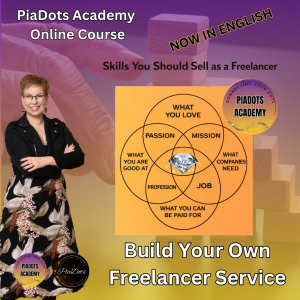
Freelancing
When a company needs execution and concrete results.
You will not just learn what these are.
You will understand when companies choose each one and how you position yourself accordingly.
What you will walk away with
A clear way to describe your skills so that a Finnish decision-maker immediately understands your value.
A stronger position in both visible and hidden job markets.
A practical way to turn your expertise into opportunities across multiple working models.
And most importantly:
A shift from trying to be chosen
to becoming an obvious choice.
Because companies are not looking for more CVs.
They are looking for clarity.
And once you understand how your skills are actually bought, everything changes.